
Perimenopause and Anxiety: Why Your Hormones Are Hijacking Your Calm (and What Helps)

Maybe you were always the calm one, able to handle deadlines, family chaos, and tough-tough-difficult conversations with ease. But in your late 30s or 40s, things began to shift. Now, your heart might race over small setbacks. You could find yourself awake at 3 a.m., your mind racing. You might feel irritable or worried for no clear reason. The confusing part is that nothing big in your life has changed. So what’s happening?
I see this pattern often in my work with women in midlife. It’s rarely a case of suddenly developing an anxiety disorder. More often, perimenopause and hormonal changes are affecting how your brain handles stress, mood, and sleep. The good news is that understanding what’s going on can make things easier to manage. The tough part is that many women are never told this could happen, so they end up wondering what’s wrong with them.
In this article, you’ll learn how perimenopause and anxiety are connected, what symptoms to look out for, and what proven options can help you start feeling like yourself again.
What Perimenopause Is (And Why It's Different From Menopause)
Perimenopause is the phase before menopause, usually starting in your late 30s or 40s and lasting anywhere from a few years up to a decade. During this time, your ovaries slowly make fewer hormones, but the process isn’t steady. Estrogen and progesterone levels can fluctuate from week to week. Your brain, which has relied on these hormones for years to help manage mood, sleep, temperature, and stress, has a hard time adjusting. (Joffe & Wit, 2020)
Menopause is defined as the point when it’s been 12 months since your last period. Perimenopause covers the unpredictable years leading up to it. It’s actually during perimenopause, not menopause itself, when anxiety is most likely to show up or get worse. (Perimenopause and Anxiety, 2023)
Why Perimenopause Causes Anxiety: The Brain-hormone Connection
This isn't "all in your head", and it isn't a sign you're getting weaker. It's neurochemistry. Three connected mechanisms explain most perimenopausal anxiety:
1. Falling progesterone disrupts your brain's calm system
Progesterone helps activate GABA, the brain's main "brake pedal" neurotransmitter. GABA quiets racing thoughts and helps you fall asleep. In perimenopause, ovulation becomes irregular, and progesterone often drops earlier and more sharply than estrogen. When GABA function is impaired, anxious thoughts, stress sensitivity, and insomnia increase. (Prior et al., 2023)
2. Estrogen variability affects serotonin
Estrogen helps regulate serotonin, the neurotransmitter most associated with mood stability. When estrogen swings unpredictably, serotonin levels swing too, which is why perimenopausal anxiety often feels different from earlier anxiety: it can come out of nowhere, with no clear trigger, and pass just as suddenly. (Perimenopause and Anxiety, n.d.)
3. Cortisol, the body’s main stress hormone, can interact with symptoms like hot flashes, night sweats, and disrupted sleep to leave your nervous system feeling more on edge during perimenopause. (Perimenopause and Anxiety, 2023) According to the Sleep Foundation, people going through perimenopause face a higher risk of experiencing sleep disruptions, which may contribute to feelings of heightened stress. Over months and years, this changes your baseline. You're not imagining feeling more on edge; your physiology has shifted.
In my practice
Many of my perimenopausal clients arrive convinced something is fundamentally wrong with them because their usual coping skills suddenly stopped working. The relief on their faces when I explain the hormonal mechanism is real. This isn't weakness or backsliding it's a documented neurological shift. And once we name it, the work of managing it can begin.
Symptoms Of Perimenopausal Anxiety
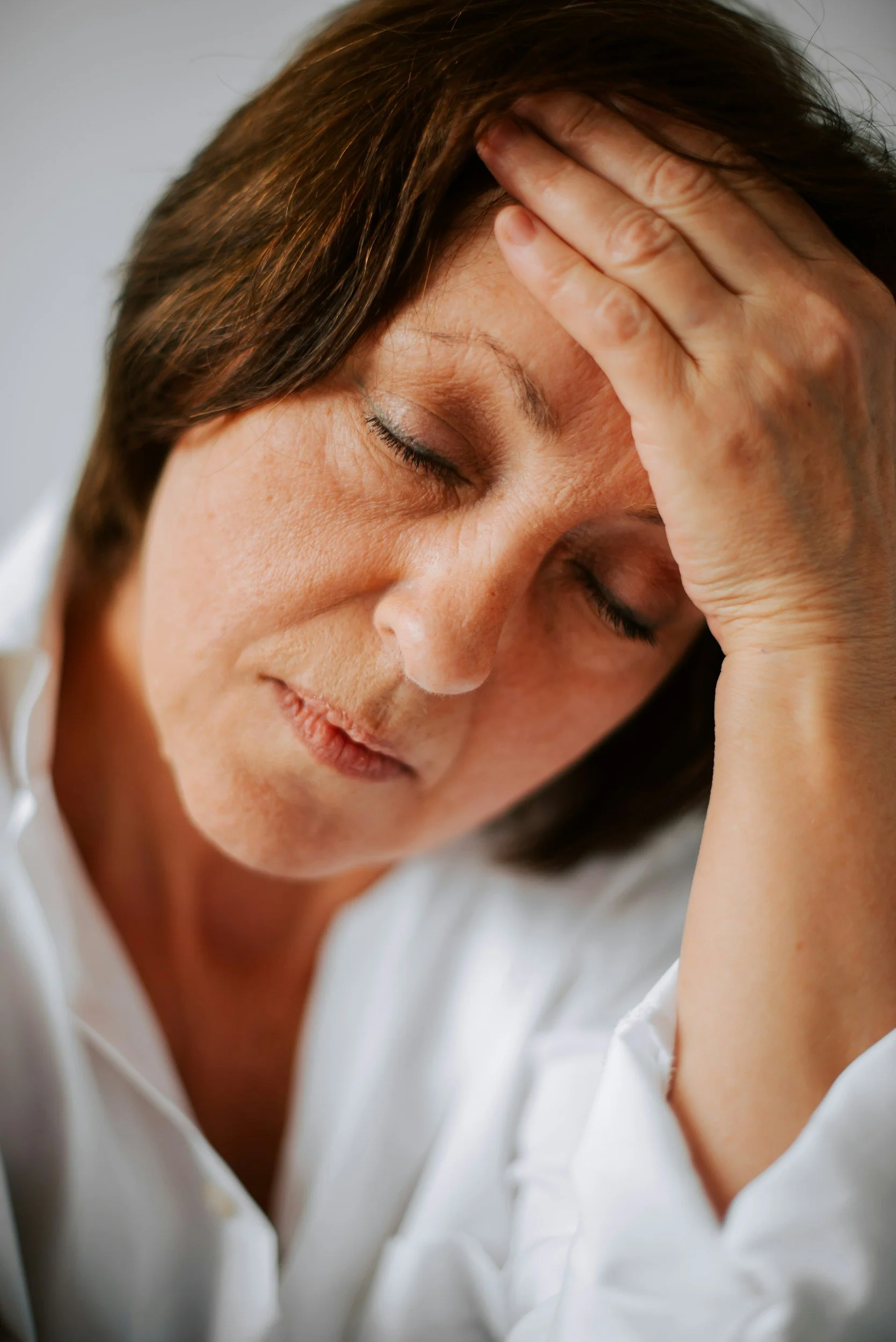
Anxiety during perimenopause doesn’t always look like typical anxiety. Signs that hormones are playing a role include:
New-onset anxiety with no prior history, appearing in your late 30s or 40s
Anxiety that comes in waves rather than constant, sometimes intense for a few days, then easing.
Heart palpitations, especially at night or when waking suddenly
Waking at 2–4 a.m. with a racing mind and inability to fall back asleep
Irritability that feels disproportionate to the situation
Increased physical sensations: tight chest, jaw tension, shallow breathing
Anxiety that worsens in the days before your period (or what's left of your cycle)
Brain fog and difficulty concentrating alongside the anxiety
A sense of "I don't recognise myself anymore"
Around 40 to 50 per cent of women in perimenopause report having significant mental health symptoms. (Balasubramanian et al., 2026) The risk is even higher if you’ve had anxiety, depression, or PMS in the past. (Balasubramanian et al., 2026)
What Actually Helps
1. Therapy that's informed by perimenopausal physiology
Cognitive Behavioural Therapy (CBT) and mindfulness-based therapies have the most evidence for helping with perimenopausal anxiety. (Tapia et al., 2026) The key is to find a therapist who understands that this is more than just stress; it’s a brain and body transition that needs both to be addressed. In my practice, I use somatic approaches and Internal Family Systems along with traditional methods to help clients work with their nervous system, not against it.
2. Sleep first, everything else second
Poor sleep can make perimenopausal anxiety much worse, while good sleep can help you feel better quickly. Try to keep your bedroom cool, stick to a regular bedtime, avoid screens for an hour before bed, and skip alcohol for at least three hours before sleeping. If night sweats are waking you up, talk to your doctor; there are ways to help.
3. Movement (the specific kind matters)
Aerobic exercise like brisk walking, jogging, dancing, or swimming can lower anxiety and depression and help you sleep better during perimenopause, according to a 2022 study by Zhao and colleagues. But pushing yourself to the point of exhaustion can actually raise stress hormones.
4. Talk to your doctor about hormonal options
Hormone therapy (HRT) isn’t meant to treat anxiety by itself, but for some women, especially if anxiety is closely tied to severe hot flashes or night sweats, it can really help with sleep and break the cycle those symptoms cause. Talk to your GP, gynaecologist, or a menopause specialist about whether this might be right for you.
5. Watch what's making it worse
Many women become more sensitive to caffeine during perimenopause. (Altered activity of xenobiotic detoxifying enzymes at menopause: A cross-sectional study, 2020) Research shows that alcohol can lower the amount of REM sleep you get, even if it doesn’t affect deep sleep. The link between sugar and mood is still debated, according to a 2019 meta-analysis. You don’t have to be strict about these things; just pay attention. Small changes in these areas often make a big difference.
When to seek professional support
Reach out to a therapist or doctor if any of these apply:
Anxiety is interfering with work, relationships, or daily functioning
You're experiencing panic attacks
You're avoiding situations or responsibilities because of anxiety
Sleep disruption has continued for more than 2–3 weeks
You feel hopeless or are having thoughts of self-harm
Standard anxiety treatments haven't worked the way they used to this is often a clue that hormonal factors need to be addressed alongside therapy.

Frequently Asked Questions About Perimenopause and Anxiety
Can perimenopause cause anxiety even if I've never had it before?
Yes, and it’s more common than you might think. Many women feel anxious for the first time in their late 30s or 40s, even if they’ve never had anxiety before. Changes in hormones like GABA, serotonin, and cortisol can cause real anxiety symptoms in people who haven’t struggled with them before. According to Johns Hopkins Medicine, perimenopausal anxiety usually gets better after perimenopause ends and hormone levels settle down, but how long this takes can vary a lot from person to person.
How long does perimenopausal anxiety last?
It’s different for everyone. Perimenopause can last anywhere from 4 to 10 years. (Perimenopause: Age, Stages, Signs, Symptoms & Treatment, 2024) For most women, anxiety gets much better after menopause, when hormone levels even out. But you don’t have to wait years to feel better; treatment can help now, and you can address both perimenopause and anxiety at the same time.
Is this anxiety or am I just stressed?
Stress and anxiety can look similar, but some signs suggest hormones are involved: if anxiety starts in midlife, gets worse before your period, comes with physical symptoms like palpitations or night waking, or if your old coping strategies don’t work anymore. A therapist can help you figure out what’s going on, and you don’t have to choose between stress and anxiety; often, it’s a mix of both, and both can be treated.
Should I try medication or therapy first?
For most women, therapy (especially CBT) has the best evidence as a first step, sometimes along with medication for more severe symptoms. Hormone therapy is a separate option that mainly helps with physical menopause symptoms, but it can also improve mood by helping you sleep better and reducing hot flashes. The best approach is to talk with both a therapist and a doctor who understand perimenopause, so you can make a decision that fits you.
Does online therapy work for perimenopausal anxiety?
Yes, research shows that online therapy works just as well as in-person therapy for anxiety. (Krzyzaniak et al., 2024) The Cleveland Clinic points out that online sessions can be especially helpful for perimenopausal women, since you can skip the commute after a rough night or join from the comfort of home. Just make sure to choose a therapist who understands that perimenopause is a unique hormonal transition with its own symptoms and not just regular stress.
If you're navigating perimenopausal anxiety and want support that takes both the hormonal and the emotional pieces seriously, we can help. Well Roots Counseling offers online therapy across North Carolina, Colorado, Vermont, Massachusetts, and South Carolina with therapists who specialise in women's mental health and the perimenopausal transition. Book a free 20-minute consultation →
References
Joffe, H. & Wit, A. d. (2020). Impact of Estradiol Variability and Progesterone on Mood in Perimenopausal Women With Depressive Symptoms. The Journal of Clinical Endocrinology & Metabolism 105(3). https://doi.org/10.1210/clinem/dgz030
(2023). Perimenopause and Anxiety. Johns Hopkins Medicine. https://www.hopkinsmedicine.org/health/wellness-and-prevention/perimenopause-and-anxiety
Prior, J. C., Cameron, A., Fung, M., Hitchcock, C. L., Janssen, P., Lee, T. & Singer, J. (2023). Oral Micronized Progesterone for Perimenopausal Night Sweats and Hot Flushes: A Phase III Canada-wide Randomized Placebo-controlled 4-Month Trial. Scientific Reports 13. https://doi.org/10.1038/s41598-023-35826-w
(n.d.). Perimenopause and Anxiety. Johns Hopkins Medicine. https://www.hopkinsmedicine.org/health/wellness-and-prevention/perimenopause-and-anxiety
(2023). Perimenopause and Anxiety. Johns Hopkins Medicine. https://www.hopkinsmedicine.org/health/wellness-and-prevention/perimenopause-and-anxiety
Balasubramanian, I., Abhijita, B., Krishnamoorthy, Y., Gnanadhas, J., Beg, M. J. & Menon, V. (2026). Prevalence and incidence of depressive, anxiety, and insomnia symptoms in perimenopausal and postmenopausal women: Systematic review and meta-analysis. General Hospital Psychiatry. https://doi.org/10.1016/j.genhosppsych.2026.03.010
(2020). Altered activity of xenobiotic detoxifying enzymes at menopause – A cross-sectional study. Environmental Research 182. https://doi.org/10.1016/j.envres.2019.109074
(n.d.). Perimenopause and Anxiety. Johns Hopkins Medicine. https://www.hopkinsmedicine.org/health/wellness-and-prevention/perimenopause-and-anxiety
(2024). Perimenopause: Age, Stages, Signs, Symptoms & Treatment. Cleveland Clinic. https://my.clevelandclinic.org/health/diseases/21608-perimenopause